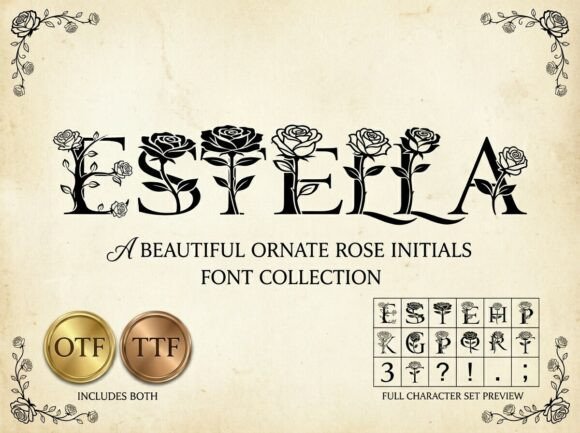
Estella: A Detailed Look at the Ornate Rose Serif Font
In the crowded landscape of digital typography, finding a typeface that successfully merges intricate artistry with functional legibility is a significant challenge. Many decorative fonts prioritize ornamentation at the expense of readability, while functional serif fonts often lack the distinct personality required for luxury branding. The Estella font attempts to bridge this gap by integrating high-contrast serif structures with hand-drawn, long-stemmed botanical elements. This article provides a professional evaluation of the Estella typeface, analyzing its design characteristics, practical applications, and potential limitations for professional use.
Design Anatomy and Visual Identity
At its core, Estella is an ornate serif font. This classification is important because it dictates the font's foundational structure. Unlike script fonts that mimic cursive handwriting, Estella relies on the sturdy, vertical skeleton of a traditional serif. This structural integrity allows the characters to maintain a sense of order and hierarchy, even when adorned with complex floral illustrations.
The defining characteristic of Estella is the integration of the floral elements. The designer has avoided simply "stamping" a rose onto a letter. Instead, the floral motifs act as climbing vines. In many instances, the thick strokes of the serif transition seamlessly into the stems of the flowers, while the thin strokes may terminate in budding petals. This creates a cohesive visual flow where the typography and the illustration are inseparable.
The contrast between the thick and thin strokes of the font is high, a trait common in Didone or Bodoni typefaces. This high contrast, combined with the added weight of the floral elements, creates a visual texture that is dense and rich. When viewed at a distance, the font creates a striking silhouette that commands attention, making it particularly effective for display purposes.
Strengths and Practical Value
The primary strength of the Estella font lies in its ability to convey a specific aesthetic narrative without the need for additional graphic elements. For designers and brand strategists, this offers a distinct efficiency. A logo set in Estella immediately communicates themes of nature, romance, heritage, and luxury. It reduces the reliance on complex logo marks or secondary illustrations because the typography itself serves as the central visual art.
Furthermore, the font demonstrates a high level of craftsmanship in its vector construction. The curves of the vines and the petals are smooth and clean, which ensures that the font scales well. Whether used on a small business card or a large-scale banner, the lines remain crisp without jagged edges. This scalability is crucial for branding assets that must function across various media, from digital screens to printed merchandise.
The "high-contrast skeleton" mentioned in its description is also a practical asset. While the decorative elements are elaborate, the underlying letterforms are recognizable. A reader familiar with the Latin alphabet can identify the letters even through the ornamentation, provided the font is used at an appropriate size. This balance allows for a design that is artistic but not alienating to the viewer.
Ideal Use Cases and Application Scenarios
Typography selection should always be driven by context. Estella is not a universal tool; it is a specialized instrument designed for specific scenarios where its unique attributes can shine. Based on its design profile, several use cases stand out as particularly strong.
- Luxury Floral and Event Branding: This is the most natural application. For high-end florists, wedding planners, or botanical gardens, Estella provides an authentic visual identity. It pairs well with textured paper stocks and minimalist layouts where the font is allowed to be the focal point.
- Packaging and Label Design: In the artisanal goods market, packaging often needs to communicate "hand-made" or "heritage" qualities. Estella is well-suited for perfume labels, gourmet teas, or organic skincare products. The botanical nature of the font suggests natural ingredients and careful craftsmanship.
- Editorial Design and Headlines: For lifestyle magazines, book covers (particularly in the romance or historical fiction genres), or blog headers, Estella can create an immersive atmosphere. It sets a mood instantly, drawing the reader into a world of elegance and sophistication.
In these scenarios, the font acts as a storytelling device. It does not just label the product; it describes the experience the consumer can expect.
Usability and Workflow Considerations
When integrating a complex font like Estella into a workflow, several practical considerations must be addressed. First, legibility is context-dependent. At small sizes, such as in body text or fine print, the intricate details of the roses may blur together, creating visual noise. Therefore, Estella should be reserved for display sizes—headlines, titles, and logos—where the details can be fully appreciated.
Second, color contrast plays a significant role. Because the font has a strong visual texture, it performs best on solid, contrasting backgrounds. Placing Estella over a busy pattern or a low-contrast image may result in a cluttered appearance. Simple backgrounds—white, cream, black, or muted tones—allow the font's details to stand out clearly.
Third, pairing requires care. Combining Estella with another highly decorative font would likely overwhelm the viewer. A practical recommendation is to pair Estella with a clean, geometric sans-serif or a simple serif for body copy. This contrast allows the ornate nature of Estella to stand out while ensuring that the supporting text remains highly readable.
Potential Limitations
No typeface is without limitations, and an honest evaluation must acknowledge them. The most obvious constraint of Estella is its niche specificity. Its strong botanical personality means it is ill-suited for corporate environments, technical documentation, or minimalist modern branding that requires neutrality. Using Estella for a financial report or a tech startup would send conflicting signals to the audience.
Additionally, the density of the design can be a challenge in layout. Because the letters carry so much visual weight, they require generous spacing (tracking). If letters are placed too close together, the floral elements will touch and merge, destroying the legibility of the words. Designers must be prepared to manually adjust kerning and tracking to ensure the text breathes.
Conclusion: Is Estella Right for Your Project?
The Estella ornate rose serif font is a valuable asset for creators who need to evoke a specific sense of romantic elegance and botanical beauty. It is a high-quality tool that rewards careful usage. For professionals in the floral, wedding, luxury, or artisanal sectors, it offers a way to elevate branding and design work with a typeface that feels both classic and unique.
However, it requires a thoughtful approach. It is not a "set it and forget it" font. To use Estella effectively, one must respect its complexity, provide it with adequate space, and pair it with simpler supporting typefaces. When these conditions are met, Estella performs exceptionally well, delivering a visual impact that is difficult to achieve with standard typefaces.