Madeline: Evaluating an Elegant Filigree Calligraphy Display Font for Luxury Design
In the search for typography that communicates heritage, luxury, and artisanal quality, designers often move beyond standard serif and sans-serif families. Madeline represents a specific category of typeface: the intricate filigree display font. It is not designed for body copy or quick legibility on screens; rather, it serves as a decorative element for high-impact headings and branding marks. This article examines the characteristics of Madeline, explores its practical applications, and helps determine where it fits within a broader design toolkit.
Understanding the Craft: What Defines Madeline's Aesthetic?
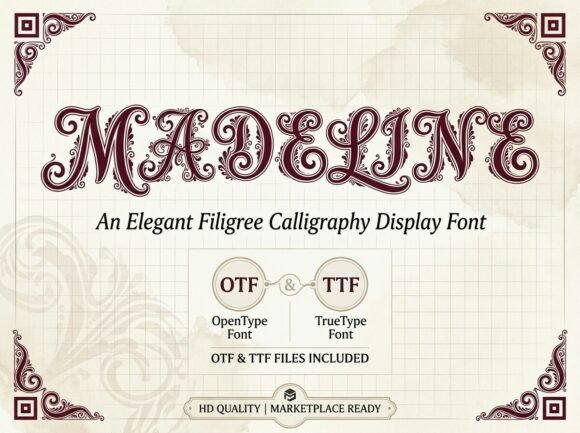
At its core, Madeline is a calligraphic display font characterized by elaborate ornamental details. Each glyph incorporates fine scrollwork, leaf motifs, and delicate curls that mimic the artistry of hand-engraved lettering. This style draws inspiration from Victorian-era typography and copperplate calligraphy traditions, where letters were treated as miniature works of art rather than simple carriers of information.
The distinctiveness of Madeline lies in its high level of decorative complexity. Unlike a standard script font that might use smooth, flowing strokes, Madeline builds its letterforms from intricate patterns. This creates a texture within the text itself. When set at a large size, the details become visible and contribute to a sense of opulence. However, this complexity also defines its primary limitation: it requires significant scale to be effective. At small sizes, the fine lines and details would merge, creating a visually dense and illegible block.
Practical Application: When Does This Style Excel?
The value of a font like Madeline is highly context-dependent. It excels in scenarios where the text itself is a focal point of the design, rather than a functional component meant for rapid consumption.
Strengths and Ideal Use Cases
- Luxury Branding and Logos: For brands in sectors like high-end jewelry, bespoke tailoring, or premium spirits, Madeline can form the basis of a distinctive wordmark. Its ornate nature conveys craftsmanship and exclusivity.
- Event Stationery: Wedding invitations, gala programs, and award certificates benefit from fonts that suggest formality and celebration. Madeline's elegant filigree adds a tangible sense of occasion to these pieces.
- Editorial and Packaging Design: On a book cover or a boutique winery label, a single line of text set in Madeline can serve as a powerful decorative headline. It captures attention and sets an immediate tonal expectation for the product.
- Digital Headers and Hero Sections: When used sparingly for a main title on a website or a social media graphic, it can create a strong visual anchor. Pairing it with a clean, simple sans-serif for body text is a common and effective strategy.
Limitations and Tradeoffs
Choosing a highly stylized font involves accepting certain tradeoffs. The primary consideration is legibility versus ornamentation. Madeline prioritizes artistic detail, which can make reading longer phrases challenging, especially for audiences unfamiliar with decorative scripts.
Another factor is versatility. A workhorse font family with multiple weights (light, regular, bold, etc.) can adapt to countless situations. Madeline, as a display font, has a more singular purpose. It is a specialized tool, not a foundational one. Overusing it within a single project can overwhelm a design and dilute its impact.
Finally, consider the technical rendering. The fine lines of filigree fonts can sometimes pose challenges in print at very high resolutions or on screen at certain pixel densities. It is always advisable to test the font at the intended output size and medium to ensure the details reproduce clearly.
Navigating Alternatives: How to Compare Display Font Styles
When evaluating Madeline, it's useful to understand how it compares to other categories of decorative and display typefaces. The choice depends on the specific mood, era, and level of complexity you wish to convey.
Comparing Ornamental Approaches
- Classic Scripts vs. Filigree Scripts: Traditional script fonts, often based on handwriting, offer fluidity and a personal touch. Madeline, with its built-in filigree, is more architectural and pattern-based. It feels less like spontaneous writing and more like deliberate, engraved artistry.
- Blackletter vs. Ornate Calligraphy: Blackletter (or Gothic) fonts evoke medieval manuscripts with strong, angular strokes. While also historical, their aesthetic is starker and more monastic. Madeline's calligraphic roots are softer, more decorative, and often associated with later, more ornate periods.
- Modern Decorative Fonts: Some contemporary display fonts use geometric shapes, inline details, or textured fills for decoration. These can feel more modern or retro. Madeline's ornamentation is firmly rooted in natural, organic forms (scrolls, leaves), giving it a timeless, rather than trendy, quality.
Decision Factors for Your Project
Ask these questions to determine if Madeline is the right fit:
- What is the core message? If the goal is to communicate heritage, romance, or artisanal luxury, Madeline is a strong candidate. For messages about innovation, minimalism, or modernity, a different style is needed.
- What is the scale of application? Will the font be used at a size where its details are visible? If not, its primary advantage is lost.
- How will it pair with other elements? Madeline requires careful pairing. It typically works best with very simple, neutral companion fonts (like a geometric sans-serif) that provide visual rest and ensure overall readability.
- Does the project have a long lifespan? Highly stylized fonts can sometimes feel tied to a specific trend. Madeline's classical inspiration gives it more staying power, but it's worth considering if the design needs to feel perpetually fresh.
Integrating Madeline into a Thoughtful Design Workflow
If you determine that Madeline aligns with your project's needs, consider these practical steps for integration:
1. Test Extensively: Don't just look at the sample glyphs. Type out the actual words and phrases you intend to use. Examine letter spacing (tracking) and line spacing (leading). The intricate details may require more generous spacing to avoid a cluttered appearance.
2. Plan for Hierarchy: Use Madeline exclusively for top-level headlines or logos. All subheadings, body copy, and captions should use a complementary, highly legible typeface. This creates a clear visual hierarchy and prevents sensory overload.
3. Consider Color and Background: A font with this much detail can become even more complex when placed over a busy background or textured image. Often, the most effective use is on a solid, contrasting color field where the letterforms can be fully appreciated.
4. Explore Licensing and Formats: Ensure the font license covers your intended use (e.g., web fonts for online projects, desktop licenses for print). Check if the font includes additional features like alternates, ligatures, or stylistic sets that can add variety to your typesetting.
Conclusion: A Specialized Tool for Specific Ambitions
Madeline is not a universal solution. It is a specialized instrument designed to evoke a very particular sense of elegance and historical craftsmanship. Its strength lies in its ability to transform a few words into a decorative centerpiece. For designers working on luxury branding, high-end stationery, or editorial projects where a Victorian or classical aesthetic is desired, it offers a level of ornamental detail that standard fonts cannot match.
The key to using it effectively is restraint and contextual awareness. By understanding its limitations—particularly around legibility at small sizes and its singular decorative nature—you can deploy Madeline where it will have the most impact. In the landscape of typeface choices, it occupies a valuable niche: the option for when ordinary elegance is not enough, and only intricate, filigree artistry will do.